The Canadian medical transportation sector is undergoing rapid transformation, and major industry consolidation reveals a critical insight: the market desperately needs innovative, technology-driven solutions that can address operational challenges while maintaining the specialized expertise healthcare logistics demands. The completion of UPS’s $1.6 billion acquisition of Andlauer Healthcare Group in November 2025 underscores this reality and highlights exactly where platforms like MedLogistics can fill essential gaps.freightwaves+2
The Growing Market Opportunity
Canada’s healthcare logistics market, valued at approximately $4.07 billion in 2025, is expanding at a compound annual growth rate of 9.1% through 2033. This growth reflects fundamental healthcare trends: an aging population requiring more medication deliveries, the rise of e-commerce in healthcare, and increasing demand for temperature-controlled pharmaceutical transportation. The cold chain logistics segment alone is projected to reach USD $6.09 billion in 2025. For an innovative platform like MedLogistics, this represents a massive addressable market of healthcare organizations, clinics, and hospitals desperately seeking better solutions.marketreportanalytics+1
However, the market’s size masks a profound challenge: despite growth, the sector remains fragmented and inefficient. Large incumbents like UPS and Andlauer focus primarily on long-haul, high-volume transportation between major facilities. This creates a critical gap for healthcare organizations—particularly mid-sized hospitals, clinics, and specialty care centers—that need flexible, intelligent routing and real-time coordination of multiple transportation partners.
Where Consolidation Creates Opportunity
The UPS-Andlauer deal reveals important truths about the current market. First, healthcare organizations are demanding better integration of their transportation logistics into broader operational workflows. Second, real-time visibility and temperature monitoring have become non-negotiable requirements. Third, the ability to coordinate across multiple transportation partners and facilities is increasingly critical as healthcare systems become more distributed and complex.ttnews+2
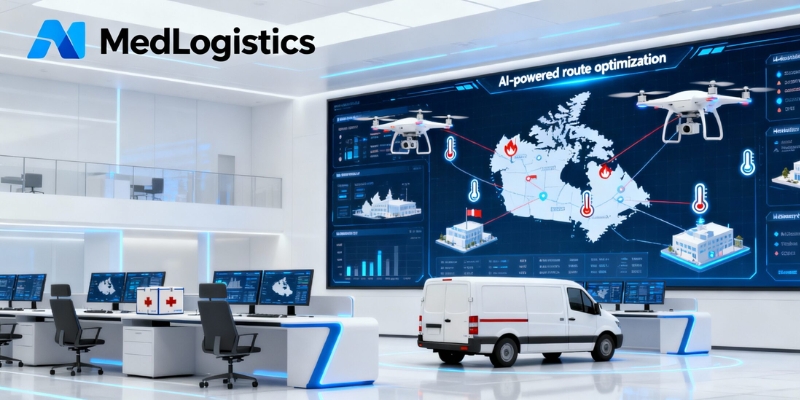
MedLogistics is uniquely positioned to address these demands. While mega-players consolidate and focus on large-scale corridor transportation, MedLogistics offers precisely what fragmented healthcare systems need: a technology platform that serves as the intelligent coordinator of medical transportation, integrating proprietary AI algorithms for route optimization, fleet management, and partner coordination while maintaining the specialized expertise and compliance rigor that healthcare demands.medlogistics
Addressing Labor Market Realities
Canada faces a persistent truck driver shortage, with approximately 25,000 vacant positions in 2025 and projections indicating over 55,000 vacancies by 2035. This isn’t going away anytime soon, and it creates a fundamental operational problem: healthcare organizations cannot rely on simply hiring more drivers. They need smarter systems.primusworkforce
MedLogistics’ AI-powered route optimization and fleet management capabilities directly address this shortage by enabling existing transportation capacity to operate more efficiently. By leveraging sophisticated algorithms to minimize travel time, reduce empty miles, and optimize schedules, MedLogistics helps healthcare organizations extract maximum value from their existing transportation resources—whether they operate their own fleets or coordinate with multiple external partners. This is not a luxury feature; it’s an operational necessity in a labor-constrained market.medlogistics
The Regulatory and Compliance Imperative
Healthcare transportation operates under stringent regulatory requirements: HIPAA compliance, electronic health record (EHR) data security, temperature maintenance logging, background checks, and specialized driver training. These requirements create permanent operational overhead for healthcare organizations and transportation providers.technavio+1
MedLogistics transforms compliance from a burden into a systematic advantage by automating temperature monitoring, maintaining encrypted EHR information, and providing continuous audit trails of compliance throughout the transportation process. For a fragmented market where smaller transportation partners may lack sophisticated compliance infrastructure, MedLogistics becomes the enabling layer that allows healthcare organizations to confidently extend their networks to new partners without manually verifying every operational detail.medlogistics
Why Big Players Miss the Market’s Middle
Large consolidators like UPS optimize for volume and geographic scale. They excel at moving thousands of packages across major logistics corridors. However, healthcare organizations increasingly operate distributed networks: a clinic coordinating specimen pickup from multiple collection sites, a hospital managing equipment deliveries across several satellite facilities, a specialty pharmacy coordinating patient deliveries across a metropolitan area.
These operational challenges don’t fit neatly into the large-scale logistics model. They require intelligence, flexibility, and deep understanding of healthcare-specific constraints. MedLogistics, by focusing specifically on the medical transportation problem and leveraging AI to optimize for healthcare’s unique requirements, serves a market segment that even well-capitalized incumbents struggle to address profitably.medlogistics
Government Support for Healthcare Technology Innovation
Canadian federal and provincial governments are actively investing in healthcare innovation. The federal government committed $26 million specifically to AI-powered projects designed to drive healthcare innovation, and announced a $200 billion investment over ten years to enhance healthcare access. This policy environment actively supports technology platforms that improve healthcare system efficiency.precedenceresearch+1
MedLogistics directly aligns with these priorities by using AI to improve healthcare logistics efficiency and ultimately enhance access to medications, medical supplies, and equipment. Platforms like MedLogistics represent exactly the type of innovation-driven solution that government initiatives seek to support and scale.
The Technology Maturity Moment
The broader healthcare transportation market has reached a technology inflection point. Real-time tracking, IoT-enabled temperature monitoring, GPS integration, and AI-based route optimization have moved from cutting-edge innovations to table-stakes capabilities that healthcare organizations increasingly expect. MedLogistics’ platform—built from the ground up to leverage these technologies specifically for medical transportation—arrives at precisely the moment when healthcare organizations are actively seeking these capabilities.openpr+2
Meanwhile, larger incumbents often struggle with legacy system integration, internal organizational inertia, and conflicting priorities across their massive service portfolios. MedLogistics’ focused mission and modern technology architecture enable it to move quickly and deploy capabilities that large, established players struggle to prioritize.
Building the Ecosystem
The future of healthcare logistics lies not in monolithic providers controlling every aspect of transportation, but in intelligent platforms that orchestrate specialized partners. The market is already moving in this direction: the UPS-Andlauer deal includes partnerships and integration strategies precisely because no single provider can efficiently handle every segment of healthcare transportation.about.ups+2
MedLogistics’ strategy of partnering with existing transportation providers while providing the intelligent coordination layer positions it perfectly for this ecosystem evolution. Healthcare organizations increasingly want to work with multiple, specialized providers coordinated through a single intelligent platform—not with massive generalist logistics companies trying to handle everything.medlogistics
The Path Forward
The Canadian medical transportation market is growing rapidly, consolidating among major players, and simultaneously creating space for innovative platforms that address specific operational challenges. MedLogistics’ combination of healthcare-specific expertise, AI-powered optimization, regulatory compliance automation, and partner ecosystem orchestration directly addresses the gaps that consolidation creates.
As healthcare organizations face persistent labor shortages, regulatory complexity, and operational fragmentation, they will increasingly seek platforms that transform these challenges into competitive advantages. MedLogistics is positioned to become the intelligent coordination layer upon which modern healthcare logistics operates in Canada—not by competing with UPS and other large-scale providers, but by orchestrating them into systems that healthcare organizations actually need.
The market’s evolution toward more sophisticated, technology-enabled healthcare logistics isn’t a threat to innovative platforms like MedLogistics—it’s the exact environment in which they thrive.
- https://www.freightwaves.com/news/ups-expands-healthcare-reach-with-completion-of-andlauer-healthcare-deal
- https://www.ttnews.com/articles/ups-acquires-andlauer
- https://about.ups.com/sg/en/newsroom/press-releases/our-strategy/ups-acquires-andlauer-healthcare-group-for–1-6-billion–acceler.html
- https://www.marketreportanalytics.com/reports/canada-healthcare-logistics-market-9315
- https://www.mordorintelligence.com/industry-reports/canada-cold-chain-logistics-market
- https://medlogistics.co
- https://primusworkforce.com/blog/truck-driver-shortage-in-canada/
- https://www.technavio.com/report/healthcare-logistics-market-in-canada-industry-analysis
- https://www.precedenceresearch.com/healthcare-transportation-services-market
- https://www.newswire.ca/news-releases/digital-announces-26m-in-ai-powered-projects-to-drive-innovation-in-canadian-healthcare-832266798.html
- https://www.openpr.com/news/4121426/canada-frozen-food-and-pharma-cold-chain-logistics-outlook