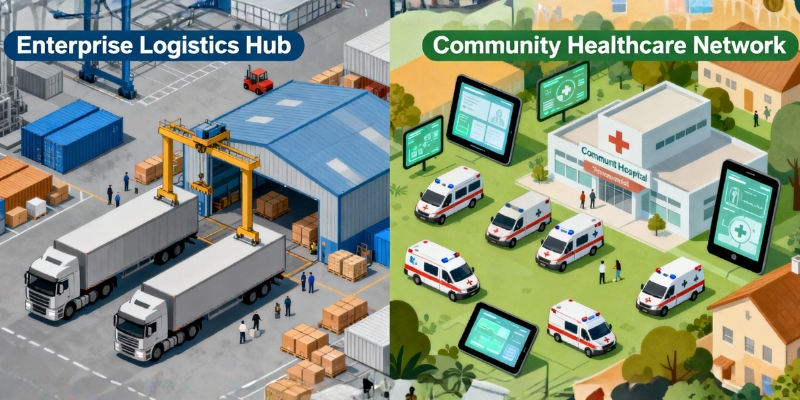
The November 2025 completion of UPS’s $1.6 billion acquisition of Andlauer Healthcare Group represents a watershed moment for Canada’s healthcare logistics landscape, but not equally for everyone. While large healthcare systems will gain access to enhanced logistics services and improved integration capabilities, mid-market healthcare providers face a troubling reality: industry consolidation is accelerating precisely when they need flexible, intelligent logistics solutions most.
The Consolidation Paradox: Growth Concentrates at the Top
The UPS-Andlauer transaction is emblematic of a broader healthcare trend that directly impacts mid-market providers. Over the past decade, healthcare logistics has consolidated around large, vertically integrated enterprises capable of delivering scale, technology platforms, and end-to-end supply chain solutions. UPS’s stated goal, doubling healthcare logistics revenue to $20 billion by 2026, depends entirely on capturing share from this consolidated market segment.
However, this consolidation creates a peculiar market structure. Large academic medical centers and provincial health systems negotiate directly with mega-logistics providers, leveraging their bargaining power to secure premium service levels. Meanwhile, mid-market providers, the community hospitals representing 90% of Canada’s hospital landscape, specialty clinics, regional networks, and independent practitioners find themselves increasingly squeezed.
The Financial Squeeze Intensifies
Mid-market healthcare providers operate under extraordinary financial constraints. Community hospitals, which provide the majority of direct patient care in Canada, face persistent sustainability challenges including staffing shortages, limited access to capital, and health inequities in resource allocation. The median hospital profit margin stands at just 3.5%, a razor-thin margin that leaves no room for operational inefficiency.
The healthcare supply chain creates asymmetrical price pressures that disproportionately impact mid-market providers. While pharmaceutical suppliers and logistics companies can pass fuel surcharges, inflation, and transportation cost increases directly to healthcare providers, hospitals themselves operate under multi-year reimbursement contracts that cannot be adjusted frequently. This creates a structural squeeze: transportation costs, a major line item for healthcare logistics. are rising rapidly, but mid-market providers cannot raise prices to offset these increases.
The impact is stark. Transportation costs have spiked due to fuel inflation, driver shortages, and the need for specialized temperature-controlled equipment, directly straining already-stretched operational budgets. For smaller providers with limited economies of scale, these cost pressures translate directly to service cutbacks or reduced quality.
Why Large Logistics Consolidators Miss the Middle Market
The UPS-Andlauer deal underscores a critical insight: mega-logistics providers optimize their networks for high-volume, long-haul transportation between major facilities. UPS’s approximately 60% revenue from temperature-controlled ground transportation, coupled with its integration of Andlauer’s established brands (ATS Healthcare, Boyle Transportation, Skelton Truck Lines), creates a formidable corridor player. But this strength paradoxically creates a vulnerability in serving mid-market healthcare organizations.
Mid-sized hospitals, specialty clinics, and regional healthcare networks operate fundamentally different logistics challenges than large integrated systems. A community hospital managing specimen pickups from multiple collection sites, a specialty pharmacy coordinating patient deliveries across a metropolitan area, or a regional network coordinating equipment transfers across several satellite facilities all require flexibility, local knowledge, and intelligent coordination that the large-scale logistics model struggles to provide profitably.
Large consolidators excel at optimizing predictable, high-volume flows. They achieve economies of scale by moving thousands of packages along established corridors. But mid-market healthcare providers need something different: they need platforms that intelligently coordinate across multiple partners, optimize for local complexity, and adapt dynamically to changing operational requirements. This is precisely where the business model of large-scale logistics providers breaks down.
The Research Infrastructure and Technology Gap
The mid-market provider challenge extends beyond mere logistics. Community hospitals, which provide the majority of patient care across Canada, face systemic infrastructure gaps that compound their competitive disadvantage. These institutions typically lack research infrastructure, limited research experience among clinical staff, and organizational cultures that haven’t historically prioritized technology adoption. Unlike large academic medical centers, which benefit from sustained investment and established technology ecosystems, mid-market providers struggle to build modern supply chain management systems.
This infrastructure gap directly impacts logistics. Mid-market healthcare organizations lack the sophisticated supply chain expertise and technological infrastructure that would allow them to optimize transportation independently. When these providers outsource logistics functions to third parties, they lose visibility into critical operational details and cannot effectively manage supply disruptions or operational inefficiencies.
Meanwhile, the inability to leverage group purchasing organization (GPO) pricing or negotiate optimal terms during supply disruptions forces mid-market providers to purchase substitute products at inflated costs and negotiate independently, a costly position compared to the bargaining power of large, consolidated systems.
The Rural and Distributed Network Challenge
For mid-market and rural healthcare providers, transportation challenges take on additional dimensions. Rural healthcare organizations face profound accessibility barriers: lack of mass transit options, considerable distances to specialized care, population decline, and fragmented transportation services. The Patient Transfer Network, designed to coordinate emergency transportation in rural British Columbia, has repeatedly failed to provide reliable, efficient service due to communication breakdowns, lack of geographical knowledge, and operational inefficiency.
These operational challenges create persistent delays and service failures that have real consequences for patient outcomes. Yet the scale of rural healthcare markets, lower volume, greater geographic dispersion, more complex logistics, makes them structurally unattractive to large logistics consolidators. Mid-market rural providers, facing both operational challenges and limited technology infrastructure, increasingly find themselves unable to access logistics solutions designed for larger-scale operations.
The Competitive Dynamics: Larger Systems Pull Away
Healthcare consolidation accelerates this divergence. As large hospital systems acquire community facilities and consolidate operations, they gain bargaining power with major logistics providers. After large healthcare systems acquire smaller providers, they often rationalize operations around consolidated logistics, preferring integrated solutions from mega-providers rather than coordinating multiple local vendors.
This reinforces a troubling dynamic: large providers benefit from improved logistics integration and service levels, while mid-market providers lack the scale to negotiate favorable terms and the infrastructure to manage complex logistics independently. Hospital consolidation itself can increase costs by 15-65%, partly through reduced competitive pressure on logistics and other services.
Addressing the Market Gap
The UPS-Andlauer acquisition and broader consolidation trends reveal a critical market gap: mid-market healthcare providers desperately need logistics platforms specifically designed for their operational complexity, not solutions repurposed from large-scale enterprise logistics. These providers require:
Flexibility and Local Intelligence: Platforms that coordinate across multiple transportation partners and adapt to distributed network requirements, not standardized corridor solutions.
Financial Accessibility: Solutions that improve logistics efficiency without requiring massive upfront technology investments or long-term enterprise contracts.
Regulatory and Compliance Expertise: Specialized knowledge of healthcare-specific requirements, HIPAA compliance, temperature control, EHR integration, specialized handling, without the complexity of enterprise implementations.
Distributed Network Optimization: AI-powered routing and coordination that improves efficiency across multiple facilities and transportation partners, directly addressing mid-market providers’ structural challenges.
This market segment, representing the majority of Canadian healthcare delivery and facing the most severe operational and financial constraints, remains substantially underserved by consolidating mega-providers focused on high-volume corridor transportation.
The Path Forward: Innovation Over Consolidation
The healthcare logistics market’s evolution reveals a paradox: as consolidation accelerates at the top, market opportunities expand at the middle. Mid-market healthcare providers face mounting pressure from financial constraints, transportation challenges, and operational complexity. Yet their sheer number, community hospitals representing 90% of Canada’s hospital landscape, and their critical role in patient care create a compelling market opportunity for platforms specifically designed to address their needs.
The UPS-Andlauer deal signals that mega-logistics providers are doubling down on large-scale, high-volume transportation. This strategic choice creates space for innovative platforms that address the distinct operational requirements of mid-market healthcare organizations, providing the intelligent coordination, regulatory expertise, and financial accessibility that large consolidators struggle to deliver profitably.
For mid-market healthcare providers, the consolidation wave is not a threat to be passively accepted, but a catalyst for seeking alternative solutions specifically designed for their operational realities. Platforms that understand distributed healthcare networks, prioritize efficiency and compliance over volume, and provide flexible coordination across multiple partners represent the future of healthcare logistics for the vast majority of Canadian healthcare providers who don’t operate at enterprise scale.